Donnerstag, 26. Mai 2016

Supply chain of cashew nuts and rubber


After having spent most of the time in the villages, we also visited several rubber and cashew nut companies (processors, depots and traders) in Dawei, the hub city for many agricultural products from the Southern region of Myanmar.

Cashew nuts, betel nuts and rubber are quite popular agricultural products in our case study sites. So we decided to follow their path a little bit. This blog post will give you some impressions of what we found out so far about cashew nuts and rubber.


Cashew nuts:

A baby plant for cashew nuts: Many farmers grow the plants themselves and have small nurseries in their backyard. As soon as the plants are strong enough, they are planted on the cultivation sites.


Cashew nut trees: The farmers plug the nuts by hand.

Farmer showing us his harvest of the day.


Another farmer lady brings her harvest to the trader in the nearby big village (Kan Pauk). The trader lady (she runs a depot) weights the bag and pays the according price to the farmer.


This is the depot of the trader lady in Kan Pauk. She also trades coconut and betel nut.


The cashew nuts are then sent to Dawei by truck, where one of the larger traders (processor and depot) in a first step dries the cashew nuts for several days under the hot sun, until the nuts’ skin turns rather bright (still in the shell).


Here in this large depot, the cashew nuts are then boilt in pure water, where the nuts’ skin and the water turn black (due to the latex the cashew nuts have inside their shell).


Afterwards, many very swiftly working women open the nutshells by crashing them under a very old looking machine. The women operate the machines with a foot pedal. The now appearing nuts are separated from the black shells.


In the oven, the nuts are now roasted.
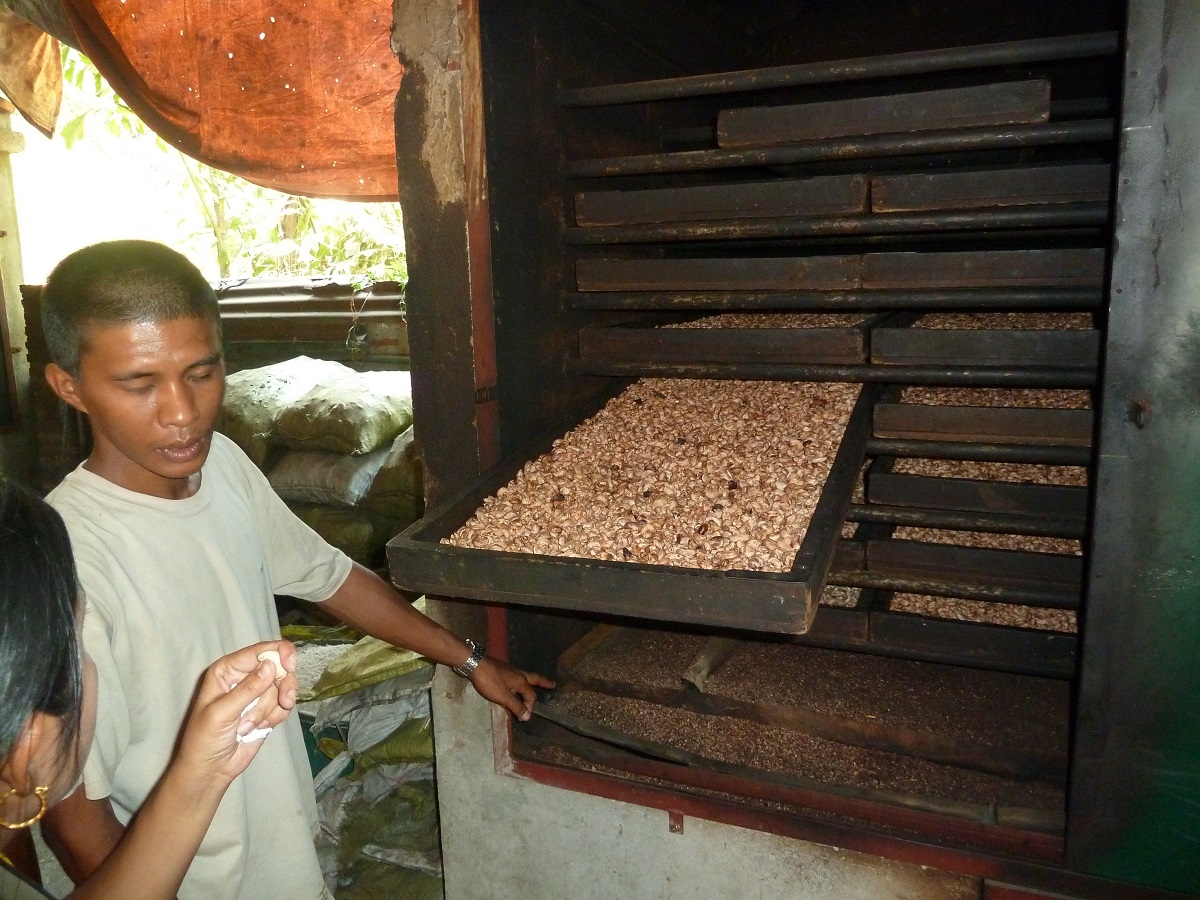


After the roasting, women, men and often also children with sure instincts (Fingerspitzengefühl) separate the remaining fine skin from the rest of the nut (similar to the peanuts, also the cashew nuts have such a very fine skin).


Now the cashew nuts are ready to be packed and shipped / transported to the markets. The nuts which are still intact can be sold for a higher price. Slightly “damaged” cashew nuts are cheaper. In packages of 10 or 20 kg, these cashews here are then sent from Dawei to the biggest market in Yangon, from where many products leave the country.


Now I understand why cashew nuts are so expensive in our supermarkets in Switzerland!


Rubber:

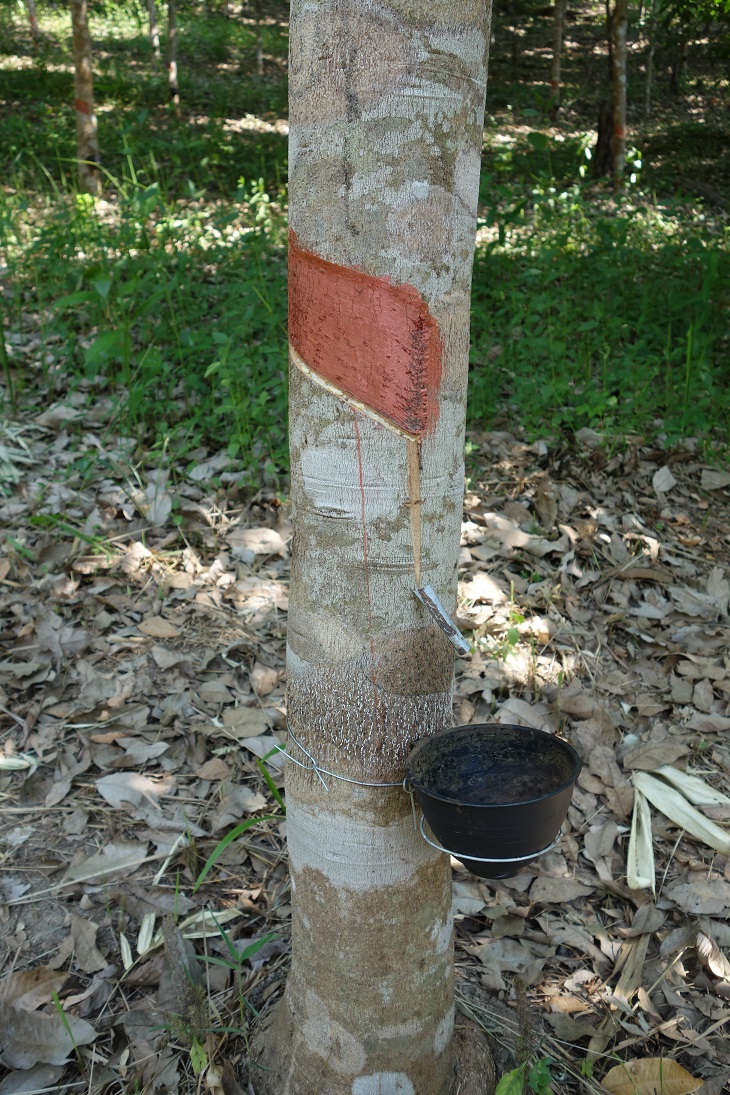
The rubber tree is wide spread in Southern Myanmar. When one cuts the bark of an adult rubber tree (usually older than 7 years), a white liquid dribs out; the original substance of latex. Wikipedia gives the following information on what the rubber liquid is often used for; and you will see, it is used for very many purposes of our Western world…

“The flexibility of rubber is often used in hoses, tires, and rollers for a wide variety of devices ranging from domestic clothes wringers to printing presses; its elasticity makes it suitable for various kinds of shock absorbers and for specialized machinery mountings designed to reduce vibration. Being relatively impermeable to gases, rubber is useful in the manufacture of articles such as air hoses, balloons, balls, and cushions. The resistance of rubber to water and to the action of most fluid chemicals has led to its use in rainwear, diving gear, and chemical and medicinal tubing, and as a lining for storage tanks, processing equipment, and railroad tank cars. Because of their electrical resistance, soft rubber goods are used as insulation and for protective gloves, shoes, and blankets; hard rubber is used for articles such as telephone housings, parts for radio sets, meters, and other electrical instruments. The coefficient of friction of rubber, which is high on dry surfaces and low on wet surfaces, leads to the use of rubber both for power-transmission belting and for water-lubricated bearings in deep-well pumps.”

Many farmers and especially also many small-scale and large-scale investors grow rubber on plantations, hoping to become rich. This was probably the case up to 6 years ago. But the price has decreased a lot over the last few years, which does not make the investors and farmers happy. Nevertheless, there is still a lot of rubber, also in our case study sites. 

This is one of the many plantations.


The liquid is extracted by cutting the bark and collecting the latex with little buckets.
 
The farmers then process the liquid with a special machine to make it thicker. Then, they pour the liquid into a form (rectangular and flat) where it becomes solid. As soon as the “mat” is solid, it is put out on a line to hang and dry a bit more.


The farmer himself or a trader then brings the rubber mats to another trader (processor and depot). Our farmers from our case study sites all send their rubber mats to Dawei. When the rubber mats arrive at the depot in Dawei, the material gets checked.


Is the rubber of high quality and already rather dry, the colour on the inside turns transparent. If the rubber mat is still not dry (high degree of moisture) and therefore of lower quality, the colour on the inside is rather white. Of course, the company pays more for high quality rubber to the farmers.


 The mats are then hung up on bamboo sticks in an oven where wood shavings are burnt. The mats get smocked and dried for several days.
Low quality mats are hanging lower (for better drying), high quality rubber mats are hanging higher (need less heat).


After the processing, bundles of 55 kg are packed together and transported to Yangon, from where the rubber again leaves the country. Some years ago, there was an illegal route to Thailand by boat (to an illegal rubber market in Thailand), but this business has been cut off. Nowadays, there’s “only” the legal market.
What you cannot see on the pictures: The rubber stinks!!! It smells like a new plastic foot mat in a car or like rain boots, but in a veeeery intense way… :-)


Village Ohn Pin Kwin


Our previous blog post was dedicated to our first case study site called Hein Ze village. Our second case study area is the village Ohn Pin Kwin (= coconut palm trees field), about which we would like to share some impressions with you. 

The Myanmar research team (f.l.t.r.): Win Myint (senior researcher and country responsibility), Lara (PhD), Thu Zar (PhD), Nwe Nwe (assistant and translator), Flurina (postdoc), Thida (PhD)

Ohn Pin Kwin has also experienced some armed conflicts and kidnapping during the fights between the army and the minorities, but was luckily more spared compared to Hein Ze. However, Ohn Pin Kwin was exposed to several land occupation incidents. These land occupations were initiated on the one hand by the Myanmar Navy and on the other hand by national and international companies (assumedly with support of the Myanmar military) in order to extract and process natural resources.

There are three major oil & gas companies settled in Ohn Pin Kwin, extracting gas from the sea, processing the gas on large compounds in Ohn Pin Kwin, and transferring the gas through pipelines to Thailand. But apparently, in return, the gas companies also invested a lot of money in the village by building a good road (which they of course also need for their trucks), building one or two schools, clinic etc.

At the fence of a company's compound - the security guy and the villager know each other and have a short chat


Additionally, this area is very mineral rich, therefore two mining companies settled in Ohn Pin Kwin (many other companies settled in neighbouring villages), extracting lead from the surface (no underground mining, but ablating the surface and destroying fertile soils).

Despite the presence of the many companies, only very few villagers still have a job with these firms. During the construction times, most villagers seem to have benefitted (through compensation or construction job). But over the last few years, most villagers lost their jobs in the companies, which still makes them having bad resentments towards the firms. Most interviewees indicated being jobless, which also leads to a higher flow of work-related emigration to Thailand.

The Navy occupied 87’265 acres of land in 2001 along the coastal zone. The reasons for this large-scale occupation of land can only be guessed: Villagers assume that the Navy on the one hand wants to protect the gas extraction in the sea and the upcoming SEZ, and on the other hand moved their main base from Mawlamyaing to this specific area. As a consequence, many farmers lost the access to their land and did not dare to complain. Also fishermen were affected, as the fishing area got limited and the pollution of the ships reduces the fish quantity and quality.

 
A short drive through the very large Navy compound. Here we see a freshly burnt area. We don't know what they will use it for.

In the succession of the land acquisitions initiated by the companies but in close collaboration with the government starting from 1995 and lasting until today, numerous farmers also had to give up the land they previously used for cultivations or extensive use. In return, most or some of them received compensations. Nevertheless, there are still farmers complaining about uncompensated side-effects of the land occupations, e.g. that a paddy rice field is now cut off from the previous water flow, because the underground gas pipelines changed the ground level and made the stream flowing through another field. Many villagers had similar stories to tell. And they all criticised, that the regional government would not answer their letters of complaints. But the situation is very complex and difficult to fully understand. There are also rumours (also confirmed by some villagers) that the companies only acquired unused land and the villagers only pretended to be affected in order to receive compensations. Who to believe? We don’t know. Probably both sides.

Every villager can tell a story about land occupations and decreases in production... 
 
This paddy rice field is apparently affected by the gas pipelines. Because of the higher ground level, the water doesn't flow through this field anymore. Hence, the plot is too dry and the harvest too little.

The villagers of Ohn Pin Kwin were (like in Hein Ze) very curious about our research project and happy to have us here. We again met many very kind persons, showing us their fields, houses, happy to give us interviews and serving incredibly tasty fruits. Nevertheless, we always had a little bit the impression that they perceived us as justice-fighters. We felt like they expected from us that we would help them and start negotiating with the companies in order to fight for more compensations and jobs for the villagers, which we will unfortunately not be able to do. But apparently, our sole presence in the village already led to some changes. We’ve heard that one day after we had left, the regional government showed up in the village in order to answer to the letters of complaints. :-) We never told the regional government that we’ll be in this village. But somehow they found out and maybe “remembered all of a sudden” that there were dozens or even hundreds of letters of complaints. Again; who knows…?! We most definitely don’t. :-) 

In Ohn Pin Kwin, we again conducted many interviews (around 30) and one workshop. For the workshop, we invited only 6 people, but 22 came :-) It was a very lively and good workshop! And we also did some transect walks, walking through the forests, plantations and other interesting places, taking GPS-points (for making maps later) and pictures. We also visited the fences of the large companies and drove through the Navy area to get an impression (as unflashy as possible of course… but somehow difficult because we were the only white people in this village…).


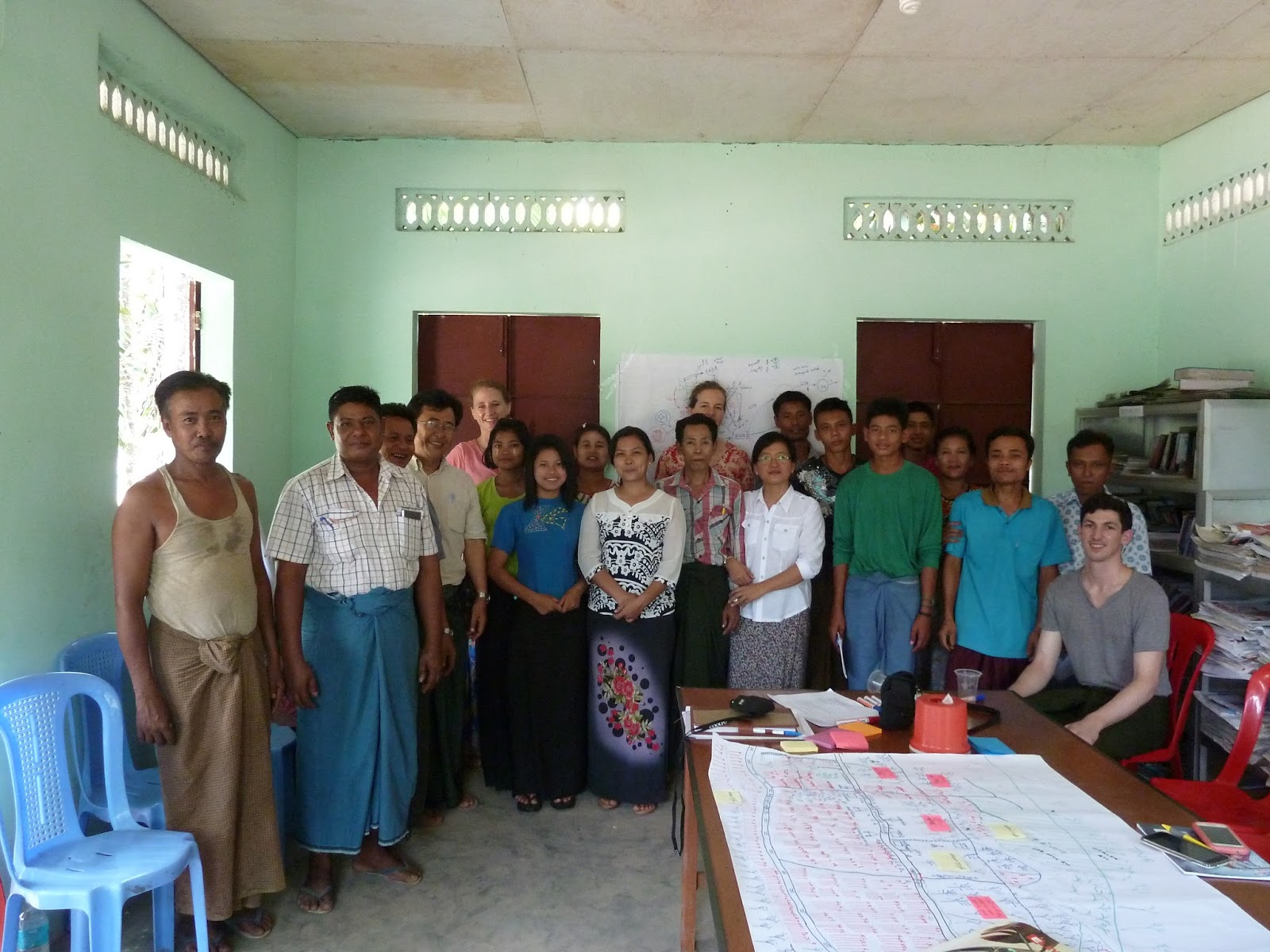
Impressions from the workshop


Our transect walk to one of the hills. First picture: take notes about the vegetation, slope etc. Second picture: take notes about further informations provided by the villagers.


In both villages, one can feel the enthusiasm about the new government. All villagers hope and expect that land governance will become more transparent, self-determined, and free of corruption with the legislation of Daw Aung San Suu Kyi. Additionally, both villages warmly welcomed our international research team, since they experienced for the first time that somebody is interested in their stories and opinions. 


  In nearly every house, you can see at least one picture of the new leader Daw Aung San Su Kyi


Sonntag, 15. Mai 2016

Village Hein Ze

After two weeks of nearly no telephone or internet access, we are again back in the little city called Dawei, and we would like to share our first experiences from one of the villages:

Hein Ze is a very small village located on the road from Yangon to Dawei. The village has experienced very harsh times during the conflicts between the government and armed minorities. Nowadays, the situation is very calm again, but every villager told us stories about them being draged away in order to serve as e.g. carriers for the army or the armed "rebels". Many villagers run away during that time and did now come back to this village and again started to cultivate the land.

Our fist transect walk through plantations and smaller plots:


The land which is used by the villagers is dominated by betel nut palm trees, rubber trees, and other minor land uses such as lime trees, banana and other fruit trees. And there is also one very large plantation of palm trees (for palm oil) and rubber trees, owned by a big investor from a distant place. But the village is also located on the border to a very large protected forest called Tanintharyi Nature Reserve. The villagers cannot use the forest plants in the protected area. But in order to still enable them to still use some of the important forest products (such as e.g. bamboo), the government also defined a so called buffer zone. Within this buffer zone, the villagers will in the future be allowed to collect forest products and maintain the wild forest. This solution seems to work out quite well.


Interviews in the village:


While the betel nut plantations are generally owned by the villagers themselves, the rubber plantations often also belong to investors from more distant places within this region. Apparently, the villagers are not too happy with this situation. But what should they do about this issue…? They are not too sure yet.

Highly motivated villagers in the workshop:


In this village, we conducted several interviews with farmers to get an overview about the land uses here and what consequences they bring for the local people. We also organized a workshop together with the villagers. We invited around 9 people, but many more came. Everybody was very enthusiastic about having a research team in their village and they didn’t want to miss out on this happening. :-)
We also had the chance to explore the area. We could go to different plantations and also the wild forest, which was incredibly beautiful (and also followed by sore muscles and bruises from falling on slippery stones several times…) :-)

Going into the wild forest, passing remote plantations, towards the boundary of the protected forest: